Three ways to make money on Phuket property: which one fits your goal and budget
Growth, rent and resale pay off in different ways and suit different budgets. As of November 2026, this is what each one realistically gives, which budget it fits, and what to check before you reserve.

| 25-30% | Normal price growth over the construction period. In strong locations with reliable developers it can reach 40%. Anything higher needs an explanation. |
|---|---|
| 5-6% | Net rental yield a year before tax, what usually stays after an honest recount. The gross figure is 8-10%; management takes 30-40% of rental income. |
| 3.5-5% | Approximate yearly price growth after completion for liquid units in new modern complexes. |
| ฿4M | Below this budget (about $123,000) the numbers rarely work as an investment. Between ฿4M and ฿8M you get roughly 40-60 m² and can rent and holiday in the same unit. |
| 6.5% | Exit costs in my example of a freehold sold for ฿12M ($369,000) after a little over four years of ownership: ฿776,000 ($23,900) in total. |
There are three ways to make money on Phuket property: price growth while the building goes up, rental income after you get the keys, and the exit, the sale that turns both into money. They work differently, and mixing them up is not worth it. High season runs from November to April, and developers always bring more launches for it, but this season there are very few, so the choice is small. I would settle the strategy before the December viewings.
The right way depends on what the property is for and how much you have. The ranges below are as of November 2026, from my practice, not a forecast for a specific unit. Whether to buy on the island at all is a separate question, covered in should you buy property in Phuket.
| Way | Normal range | Main check |
|---|---|---|
| Growth during construction | 25-30% by completion, up to 40% in strong locations with reliable developers | What the forecast is based on |
| Rental income after the keys | 8-10% gross a year, about 5-6% net before tax | Is the yield before deductions or after |
| Exit | About 3.5-5% a year after completion, for liquid units in new complexes | Who buys the unit from you in five years, and why |
How much does a unit gain while it is being built?
You buy at the start of sales, ideally before construction begins, and the price list rises as the project sells. What decides it is scarcity and uniqueness: a good location, real features, few or no similar offers nearby. A normal increase over the construction period is 25-30%. In strong locations with reliable developers it can reach 40%.
Anything above that needs an explanation. Sometimes there is one, sometimes it is the seller’s imagination. (from my post of 22 September 2026)
Two conditions have to hold: the developer finishes, and the project has no strong competition next to it. If the developer does not finish, what you stand to lose is what you paid before completion; the market risk is on the full price, because the rest, for example 50% on keys in the Central Group schedule, is due at handover. Developer and contract checks are in buying off-plan in Phuket.
What does rent leave you after costs?
Gross yield on the island is normally 8-10% a year. After an honest recount, about 5-6% net stays with you, before tax. The management company takes 30-40% of income. Then booking platforms, upkeep and utilities all year, taxes, and the low season from May to October, when the rate falls threefold and occupancy halves.
When you are shown 12% a year, the first question is whether that is before deductions or after. (from my post of 22 September 2026)
The full recount is in gross vs net rental yield, the management share in Phuket property management fees.
Which units can you actually sell at a profit?
Until you sell, the growth stays on paper. After completion, liquid units in new modern complexes usually grow about 3.5-5% a year. If there is no answer to who buys from you in five years and why, the first two ways will not save you.
Selling costs money. For a freehold there is a 2% registration fee on the government appraisal, the seller’s income tax, and specific business tax of 3.3% if you held the unit under five years, or stamp duty of 0.5% after five years. The 3.3% tax and the stamp duty are calculated on the higher of the sale price and the appraisal. In my example, a freehold sold for ฿12M ($369,000) with an ฿8M ($246,000) appraisal after a little over four years of ownership costs ฿776,000 ($23,900), about 6.5% of the price.
The foreign quota and a full worked model of the exit are in who buys your condo in five years.
Which way fits your goal and budget?
Budget is not the only question. Much more important is why you need this property: to rent it out, to come yourself, to have a resale prospect, or to move. (from my post of 3 November 2026)
The answer decides the area, the format, the form of ownership and the payment scheme.
| Budget | What it realistically buys | Which way is closer |
|---|---|---|
| Up to ฿4M (about $123,000) | Studios and one-bedrooms, mostly in central areas 7-10 kilometres from the sea | A home for yourself; as an investment it needs very careful numbers |
| ฿4-8M ($123,000-246,000) | Roughly 40-60 m² near the sea in tourist areas | Rent plus your own holidays in the same unit |
| ฿8-20M ($246,000-615,000) | Two- and three-bedrooms by the sea, branded residences, residences with 3-metre ceilings and low density | Living there yourself and renting it out |
| From ฿20M (from $615,000) | Spacious residences in the most prestigious locations, penthouses, villas with a pool away from the first line | The asset and the pleasure of it; the yield is secondary |
Below ฿4M, a unit within walking distance of the sea is hard to find even at the newest launches, and as an investment the numbers rarely work.
In the ฿4-8M band you can buy for two tasks at once, renting out and coming on holiday. This is also where most mass projects sit, so look at quality, ceiling height and density before the price.
A mixed strategy works best in residences built for living. In the new Central Group project on Bang Tao you can come for holidays and winters and rent the unit out the rest of the time. Ordinary projects, by contrast, need renovation after 2-3 years, and after about ten years they have used up their life. Above ฿20M the asset comes first; that segment is in branded residences and luxury property.
When does resale before or right after completion work?
Resale is a favourite strategy of first-time investors, but most new buildings on Phuket do not suit it, even bought at launch. You usually need all of these at once:
- An early entry into the project.
- A strong location.
- Limited supply.
- High demand after completion.
- An entry price below market.
The new Central Group project on Bang Tao is one where most of these conditions can be seen from facts. Early entry: on 22 October the price list had 79 available units at launch, and within a day about 40 were reserved. Limited supply and demand: the developer’s first project next door, The Standard, sold out during construction; my clients ask me for one- and two-bedrooms there on assignment, and there are none, because owners keep them.
Two-bedrooms of 100 m² in The Standard started at ฿16-18M ($492,000-554,000). The one such unit left is listed at ฿23,260,000 ($716,000). That is an asking price, not the price of a closed deal.
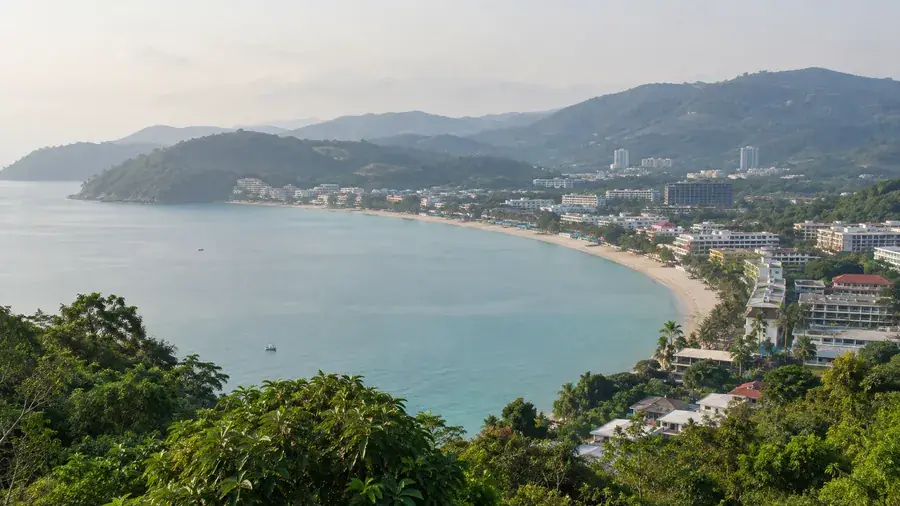
Kata and Karon show the other side. Two new projects there started at about ฿160,000-170,000 per m² ($4,900-5,200), a price I no longer call a good one for a launch. I can’t and won’t promise those units will be worth more by completion. There is almost no land around the buildings, the area’s infrastructure is old, the seasonality is strong, and many hotels nearby compete with condos for guests.
Out of the few projects on the market, pick ones with features that are hard to repeat. For the same price per metre on Bang Tao you can get an apartment in a premium project with 3-metre ceilings: the land there costs more, but the developer bought it long ago. Knight Frank also expects competition among off-plan projects to intensify after the launches of the past three to four years. The buyer’s side of selling before completion is in assignments and below-market resale.
What to check before you reserve
- Write down what the property is for: renting, your own use, resale or moving.
- Ask what the growth forecast rests on. A figure above 25-30%, or above 40% in a strong location, needs an explanation.
- Look at what is being built around, how much is already built and whether free land is left.
- Check what the developer has already built and handed over, and how much you pay before completion.
- Ask whether the quoted yield is before deductions or after, and count the whole year, May to October included.
- Find out what the management company takes and what that share covers.
- Look at ceilings, finishes and density.
- If you plan to resell, go through all five conditions above, one by one.
- Before you reserve, count the exit costs for your holding period: 2% registration, 3.3% or 0.5%, and income tax.
To see the three ways on your own case, use the calculator on the home page. It takes four inputs: your budget, the stage (a completed unit or off-plan), the scenario (rental, own use or resale) and the horizon (3, 5 or 10 years). For the three ways on a specific project and your budget, request the calculation below through my WhatsApp.
FAQ
Which is better in Phuket: growth during construction, rent or resale?
It depends on what the property is for: renting out, coming yourself, a resale prospect or moving. The answer decides the area, the format, the form of ownership and the payment scheme. For renting plus your own holidays at ฿4-8M, check ceilings and density first. For growth during construction, check what is being built around and whether free land is left. For resale, check all five conditions. I always recommend a mixed strategy rather than resale alone.
What is a realistic rental yield in Phuket?
The normal gross yield on the island is 8-10% a year. After an honest recount, about 5-6% net stays with you before tax. The difference goes to the management company (30-40% of rental income), booking platform fees, upkeep and utilities all year, taxes, and the low season from May to October, when the rate falls threefold and occupancy halves. A quoted 12% tells you little until you know whether it is before or after deductions.
Can you flip off-plan property in Phuket before completion?
With far from every project. Most new buildings are not suitable for resale even if you buy at launch. You need several things at once: an early entry, a strong location, limited supply, high demand after completion and an entry price below market.
What budget do you need to invest in Phuket property?
Below ฿4M (about $123,000) the numbers rarely work as an investment, and every one needs careful checking. Between ฿4M and ฿8M ($123,000-246,000) you get roughly 40-60 m² and can combine renting and your own holidays, but this is where most mass projects sit. From ฿8M to ฿20M ($246,000-615,000) you get two- and three-bedrooms by the sea, branded residences and low-density projects with 3-metre ceilings. From ฿20M the asset itself comes first and the yield is secondary.
How much does it cost to sell a condo in Phuket?
For a freehold: a 2% registration fee on the government appraisal, the seller's income tax, and specific business tax of 3.3% if you held the unit under five years, or stamp duty of 0.5% after five years. The 3.3% tax and the stamp duty are calculated on the higher of the sale price and the appraisal. In my example of a ฿12M ($369,000) sale with an ฿8M ($246,000) appraisal and a little over four years of ownership, the total was ฿776,000 ($23,900), about 6.5% of the price.
Sources
- Figures and positions come from Viktoria Shimanovich's own channel posts (in Russian), t.me/vikishiman. The three ways to make money, normal ranges, growth after completion and the three checks: post of 22 September 2026. About 5-6% net after an honest recount: 23 October 2026, 2 September 2026, 31 August 2026. Why most new projects do not suit resale, the five conditions and the mixed strategy: 29 June 2026. The Central Group launch on Bang Tao, The Standard, assignments, the payment schedule and renovation of ordinary projects: 26 October 2026. High season and this season's launches: 28 October 2026. Kata and Karon launches: 2 November 2026. Budgets and the question of what the property is for: 3 November 2026. Exit costs: 6 November 2026.
- Competition among off-plan projects is expected to intensify because of the large number of launches over the past three to four years: Knight Frank, Phuket Villa & Condominium Market Year-End 2025.
- Specific business tax of 3.3% on a sale within five years of acquisition, stamp duty of 0.5% where it does not apply: Thai Revenue Department.
- Dollar figures are at an indicative 32.5 ฿/$ as of November 2026, USD/THB history; recalculate on the day of the deal.
- Ranges and positions are as of 11 November 2026. They describe typical outcomes from my practice and are not a forecast for any specific unit. This is not legal or tax advice.